Trading Strategy: What It Is and How It's Built

If you're starting to explore automated trading, you'll quickly run into the term trading strategy. But what actually makes up a trading strategy, and what parts does it consist of? By the end of this article, you'll know how a strategy is built at its core, which building blocks belong to it, and how building a strategy by hand differs from one generated automatically.
A trading strategy is an if-then rule
At its core, a trading strategy can be described as a set of if-then rules: when a certain condition occurs, an action is carried out. Different strategy styles differ mainly in how these rules are structured, not in whether they're built from such rules at all. This basic form applies no matter which style a strategy later follows. It only describes the principle, not whether a given strategy actually trades successfully with it.
Conditions and actions in the EA Wizard
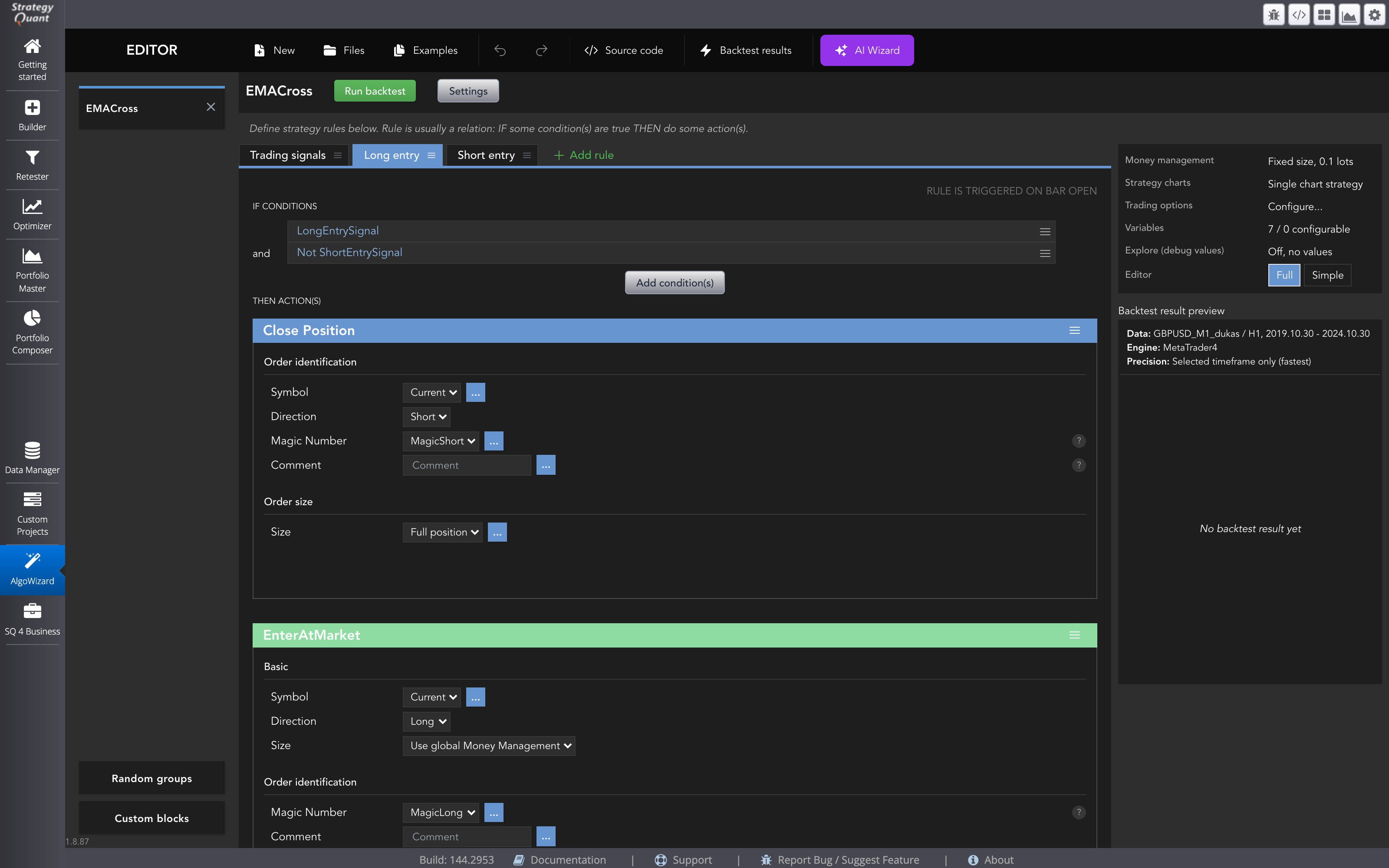
In the EA Wizard module of StrategyQuant X, a strategy is defined through trading rules, each made up of a condition and an action. The condition describes what the rule is waiting for, the action describes what happens once the condition is met. This two-part structure applies exactly as described for the EA Wizard. On its own, though, it isn't enough to produce a complete, tradable strategy: that also requires the order types and the rule set used to put such a condition and action into practice in the market.
The building blocks of a trading strategy
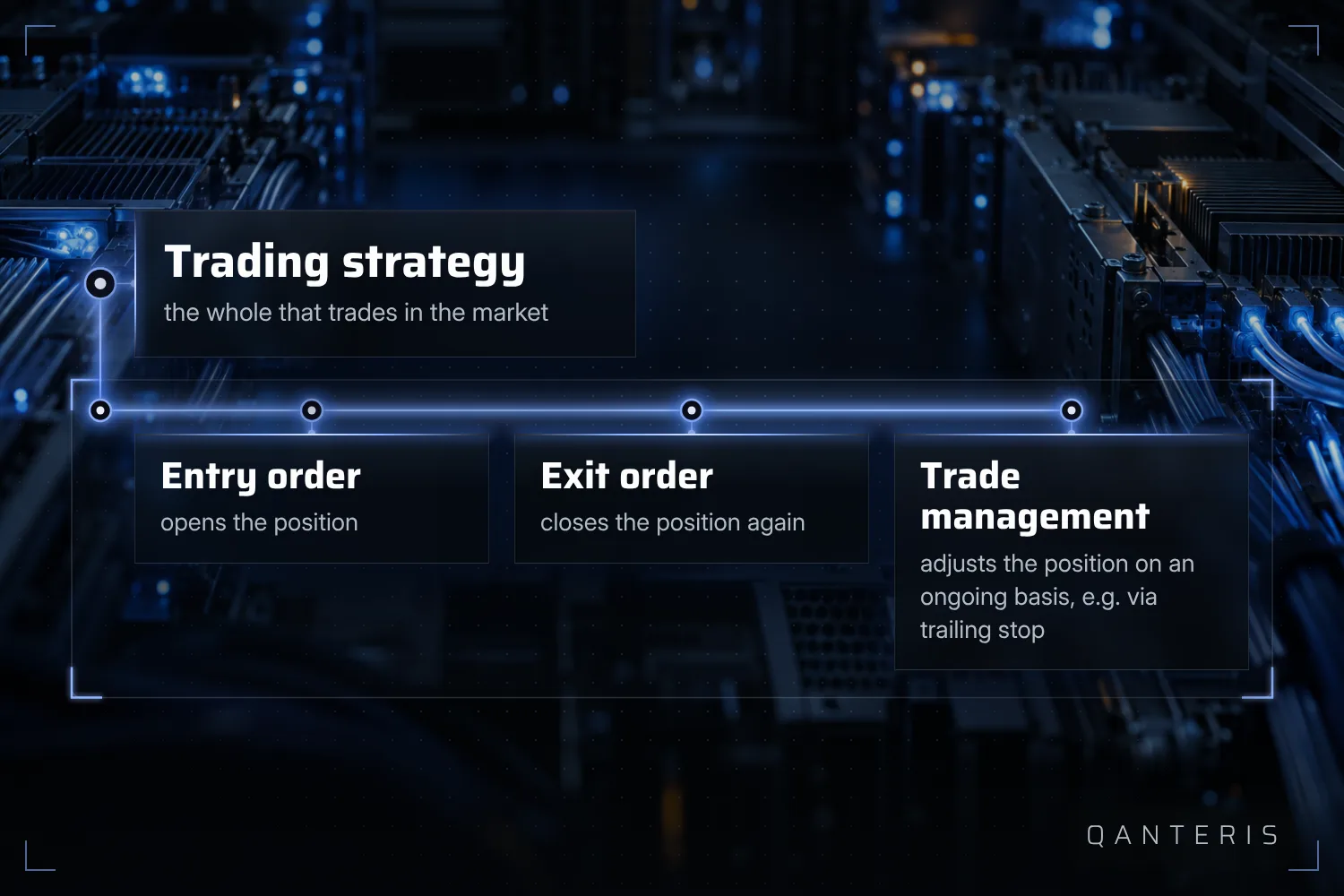
A trading strategy is made up of several elements: an entry order, an exit order, and trade management commands, for example a command that trails a stop loss. The entry order opens a position, the exit order closes it again, and the trade management commands adjust the position while the trade is running. These three elements don't replace one another: trade management commands don't make separate exit rules unnecessary.
How an initial selection of strategies is created
When StrategyQuant X builds an initial, randomly generated population of strategies, it combines price patterns, technical indicators, order types and other building blocks into entry and exit rules. That doesn't mean every strategy created this way is automatically sensible or tradable: the random combination is just the starting point from which further selection and testing happen later. A randomly generated strategy is therefore neither inherently suitable nor inherently invalid, it's initially just a proposal that needs to be checked.
The old way: building a strategy by hand
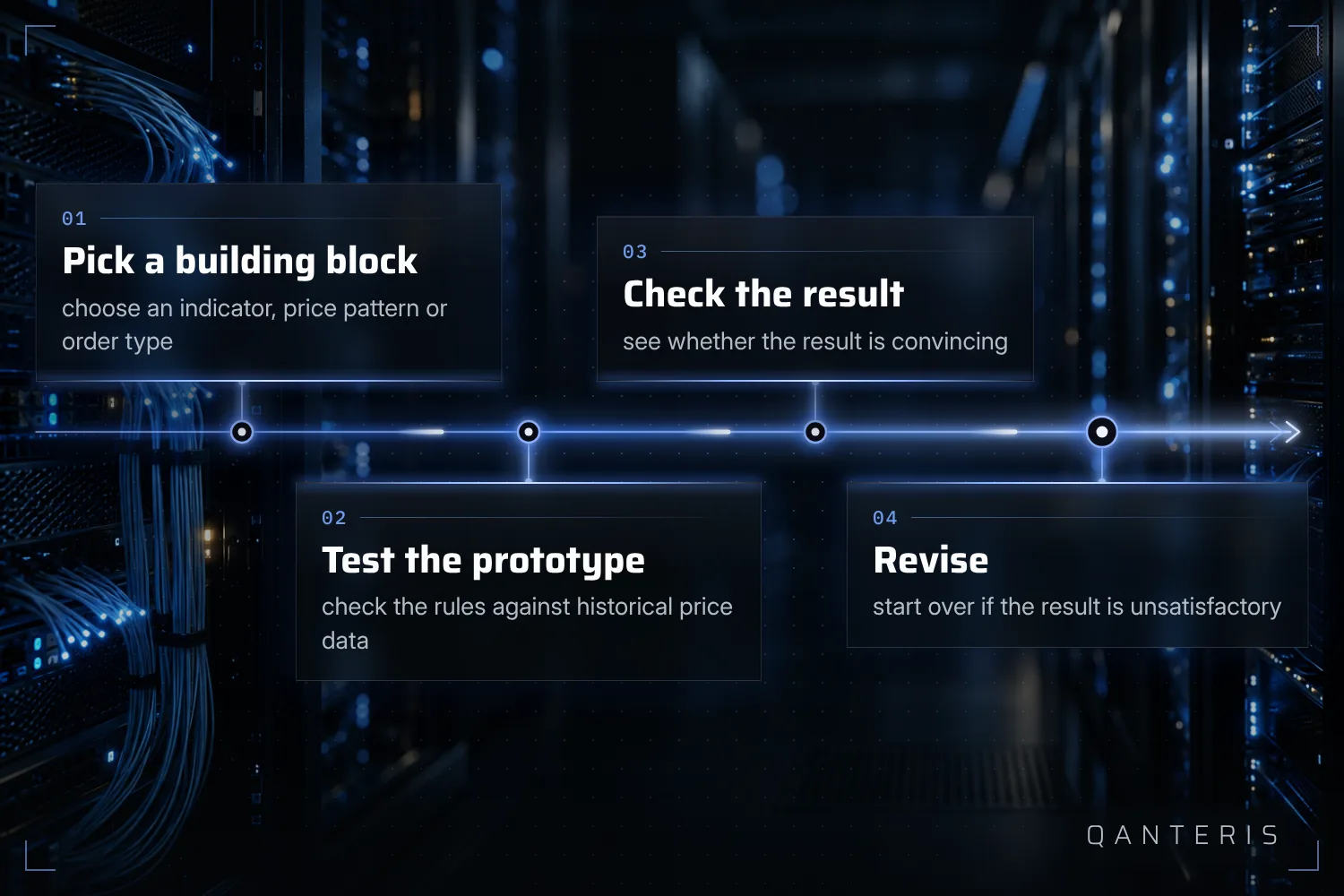
Before automated generation existed, a trading strategy was built by hand, and this path is described as a slow process of trial and error: the trader picks building blocks such as indicators, price patterns and order types, tests the prototype on historical price data, and if the result is unsatisfactory usually has to revise and retest it repeatedly. That doesn't mean manual development fundamentally doesn't work, and automated generation doesn't take testing or a trader's own judgment off their hands. Both paths end up needing a check of whether the result is convincing.
What the building blocks show, and what they don't
The building blocks presented in this article, the if-then principle, the split into condition and action, entry order, exit order and trade management, show you what a trading strategy consists of. They don't show you whether a specific strategy would have performed well in the past or how it will behave in the future. A test on historical price data, as mentioned for manual development, always describes only how a rule set would have behaved on past data, nothing more.
This article is for education only and is not investment advice. Past results, including backtests, do not guarantee future results. Trading financial instruments involves risk, and you can lose money.
This article is for education only and is not investment advice. Past results do not guarantee future results.
How do you do it? Share it in the community. Free, in your language.
Sign up free