Systematic Trading: Decision Before the Trade

Many people treat "systematic trading" as just another word for "automated trading": a program that executes trades without a human stepping in. But the key difference doesn't lie in the execution, it lies before that. In systematic trading, the rules are fixed before the first trade ever happens: entry, exit and position management are all defined in advance and tested against historical data. Whether a human then trades by these rules or software executes them automatically doesn't change that. In this article you'll see what this difference looks like in practice, which two paths StrategyQuant X offers for it, and where the limits of any historical test lie.
Two paths, one shared principle
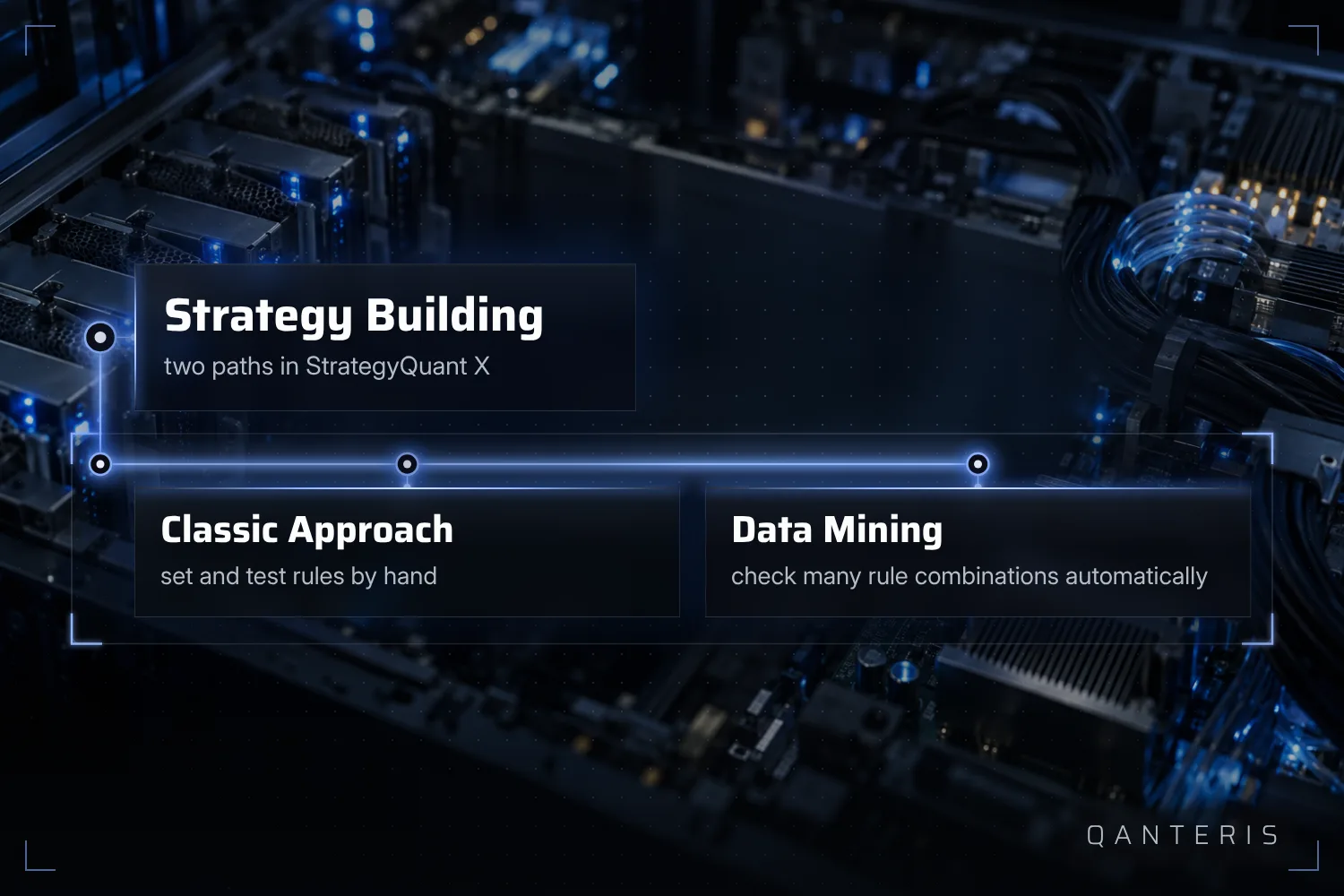
StrategyQuant X distinguishes between two fundamentally different approaches to building a trading strategy. The classic approach matches manual strategy building in AlgoWizard: you set the rules yourself. The data mining approach, by contrast, tests a large number of rule combinations to find the strategy with the highest observed historical performance. Neither path is inherently superior, and neither ensures the strategy will keep working going forward. What they have in common is the timing of the decision: the rules are set before a trade ever happens in practice.
The classic path: building and testing rules by hand
With manual, trial-and-error based building, you pick building blocks like indicators, price patterns and order types, test the prototype on historical data, and revise it if the result isn't satisfying, then test it again. This is the traditional, non-automated way of working, as opposed to automated strategy generation. Even repeating this process many times gives no assurance that the strategy will behave the same way in the future as it did in testing. Still, what matters about this path is that the rules are fixed long before they're applied in live trading, and they were tested against historical data beforehand. That's exactly what makes the approach systematic, even without software automatically searching through rules here.
The data mining path: automatically searching many rule combinations
The data mining approach in StrategyQuant X takes the reverse route: instead of testing a single rule idea by hand, the software searches through a large number of rule combinations and works out which of them would have achieved the highest observed performance in the past. This, too, is initially only a test against historical data, not a statement about the future. The difference from the classic path isn't in the principle, it's in the scale: instead of testing a handful of variants by hand, the software checks many variants automatically. The principle stays the same: set the rules before deployment and test them against historical data.
Tools that build on already tested rules
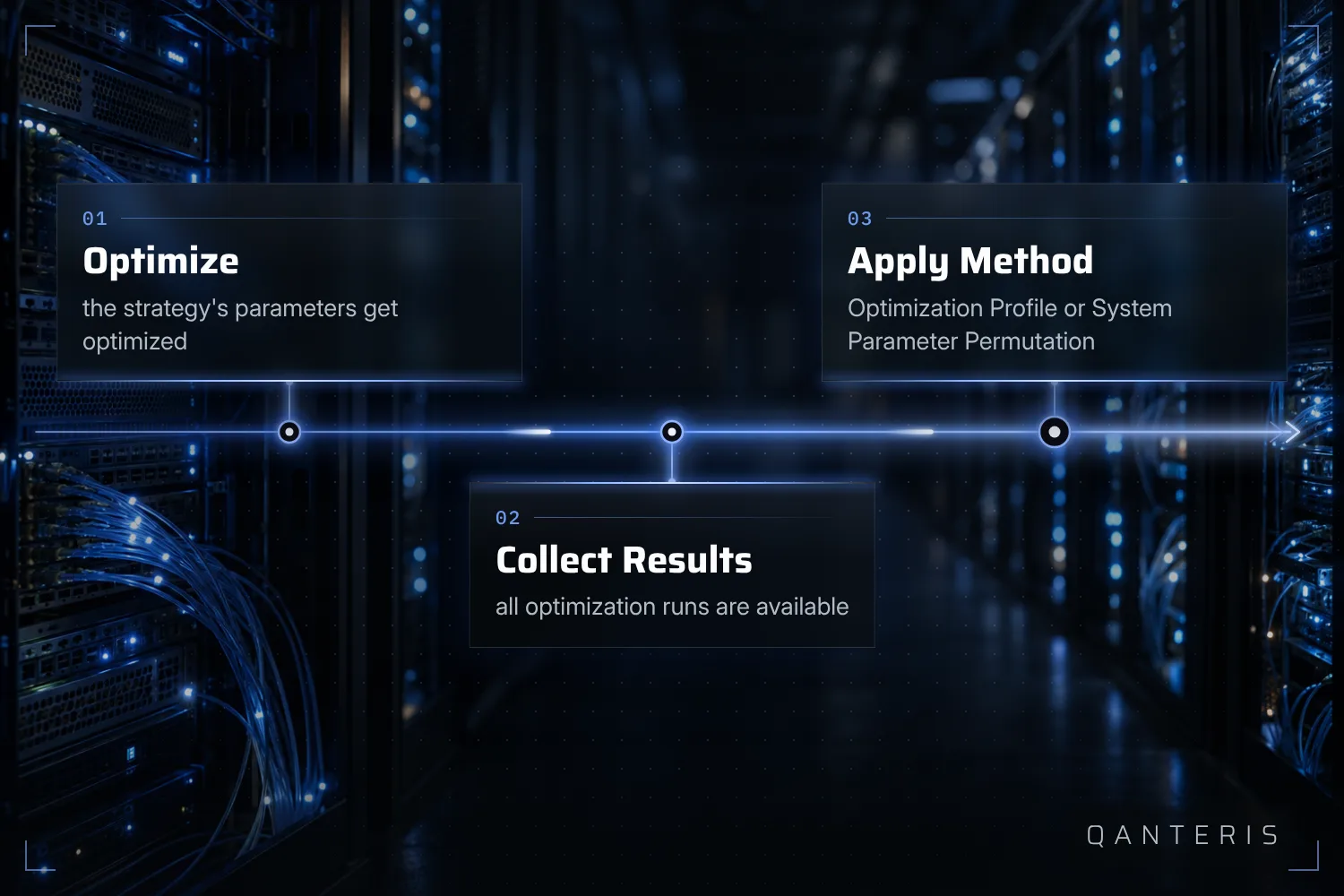
Some tools in StrategyQuant X assume that a testing step has already been completed. Optimization Profile and System Parameter Permutation both draw on the results of all optimization runs: a strategy's parameters have to be optimized first, before either method is applied to those results. This, too, shows the principle: the actual calculation step, the optimization, comes first, and the evaluation follows afterward. Neither the optimization nor either of the two methods proves on its own that the strategy under examination is robust. They only sort and evaluate results that already exist.
Monte Carlo analysis: the same simulation, repeated many times
Another example of pre-tested, repeated rule application is Monte Carlo analysis. It repeats the same simulation many times, with small random changes made on each run. According to the manufacturer's material, a larger number of repetitions increases the statistical significance, or reliability, of the aggregated results. The same limitation applies here as with every other method described in this article: more repetitions make the statement about the past more reliable, but they're no assurance that the strategy will trade profitably in the future. The analysis describes simulated past data, not a prediction.
What a historical test doesn't show
Every method described here, whether manual testing, data mining, Optimization Profile, System Parameter Permutation or Monte Carlo analysis, has one thing in common: it evaluates data that has already happened. That applies to backtests just as much as to simulations and optimizations. On its own, that says nothing about how the same rules will behave on future, not yet known market data. This isn't a weakness of any single method, it's a fundamental limit of any historical test. Anyone who sets rules in advance, whether by hand or by software, hasn't thereby shown that those rules will behave the same way in the future.
Who bears the responsibility
The responsibility for properly evaluating a new strategy and knowing its strengths, weaknesses and limits before it goes into live trading lies with the user, not with the software. That holds regardless of which of the two paths you chose and how many automated testing steps came before it. Even a passed automated test doesn't replace your own judgment on whether a strategy fits your goal and your risk tolerance.
A note on where the research comes from
Part of the manufacturer's material on evaluating and selecting strategies generated in StrategyQuant X draws on a study from 2019 and 2020. That study predates later product versions and the market conditions that have changed since then. Conclusions from it can't simply be applied to the current situation without scrutiny, they relate to the period in which the study took place.
What systematic trading can deliver, and what it can't
Systematic trading initially means just one thing: the rules are fixed before the first trade happens, and they were tested against historical data beforehand. That applies both to the classic, manual path and to the data mining path in StrategyQuant X. Automation is a possible tool for execution here, not a precondition for the principle itself. What remains open every time is how the same rules will behave on data nobody has seen yet, and that's exactly what none of the methods described here can answer on its own. That decision, evaluating a strategy and knowing its limits, stays with you.
This article is for education only and is not investment advice. Past results, including backtests, do not guarantee future results. Trading financial instruments involves risk, and you can lose money.
This article is for education only and is not investment advice. Past results do not guarantee future results.
How do you do it? Share it in the community. Free, in your language.
Sign up free