From Trading Idea to Rule Set: What a Strategy Really Needs

You have an idea: buy when the RSI drops sharply. That sounds like a finished rule, but it's only the start. A trading strategy needs exit rules and trade management rules alongside the entry condition, and those are completely missing from a plain idea like this one. If you build it anyway, the result in testing often behaves differently than you expected, simply because a large part of the needed rule set was never defined in the first place.
This article walks you through the path from trading idea to complete rule set: what it consists of, what documented process exists for it, and why a bigger parameter search alone doesn't give you a better strategy. By the end, you'll know which questions to ask about your own idea before you have it built.
Trading idea and rule set: why an RSI rule isn't enough
At its core, a trading strategy is a set of if-then rules: if certain conditions are met, the software carries out certain actions. That holds for almost every strategy style, whether trend following, mean reversion or something else entirely. The styles mainly differ in how the rules are structured, not in whether they're if-then rules at all.
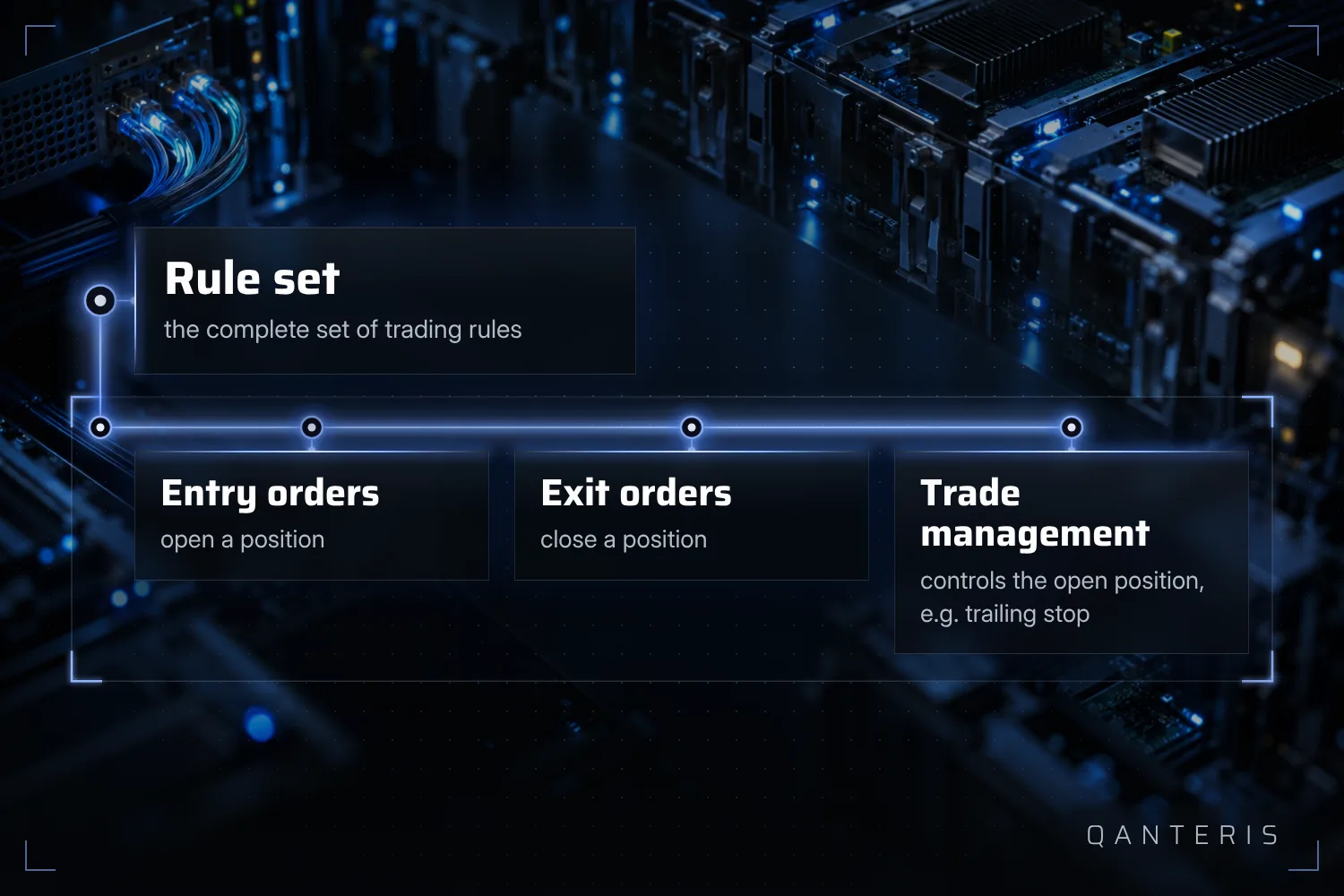
A complete rule set consists of three kinds of building blocks: entry orders that open a position, exit orders that close it, and trade management commands, for example trailing a stop loss. Your RSI idea only gives you the first block, the entry condition. Without exit rules and trade management rules, it stays a fragment, far from a complete rule set.
The documented path from rough draft to finished strategy
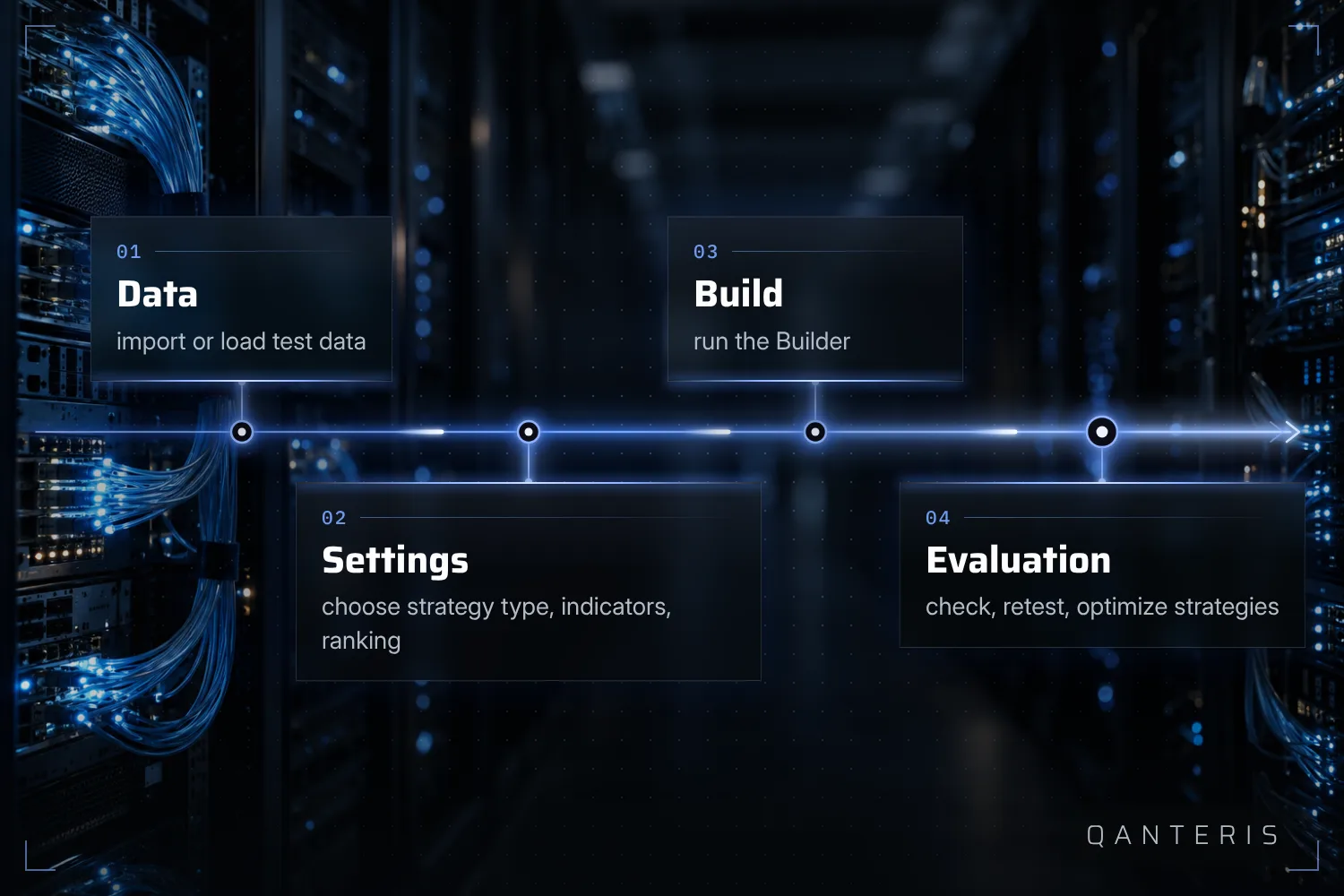
The product documentation describes a standard process for turning an idea into a strategy: you import or load test data, set things like strategy type, indicators, order types and ranking criteria in the Builder, run the build, and then evaluate the resulting strategies, retest or optimize them further. That's a documented path, not a requirement. You don't have to follow it step by step exactly as written.
An earlier documented version worked a bit differently. There, the test data was first set up with an in-sample and out-of-sample split for genetic evolution, then strategy type, indicators and order types were defined, and only at the end were the ranking options configured, to filter out strategies with too little profit. That description applies to an older version of the product; later versions can arrange it differently. So don't treat any single menu path as fixed forever. The underlying idea stays the same though: set up data and building blocks first, then build, then check.
An idea becomes a template: the path through AlgoWizard
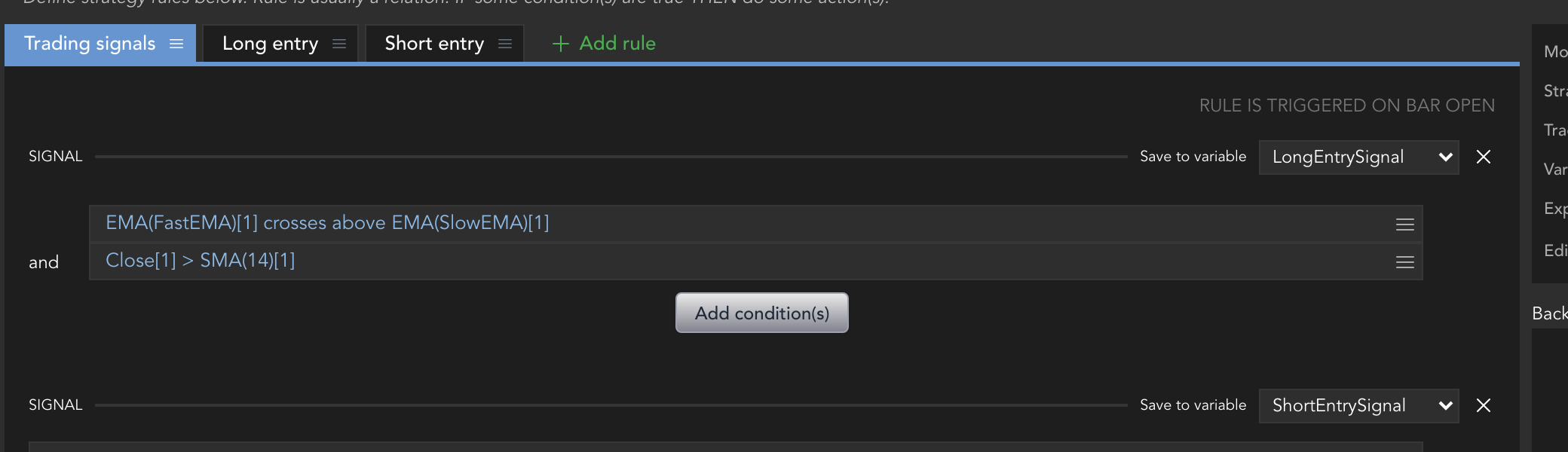
One documented, concrete way to turn a simple idea into a buildable structure runs through AlgoWizard. You create a new strategy there, switch it to template mode, and build the condition from a chosen price reference against an indicator, say a moving average with a defined parameter range. That turns your RSI idea into a structure the software can actually work with.
One thing worth knowing: as long as the strategy stays in template mode, the documentation says you can't backtest it. The mode only serves to build the structure. You can only check it once you leave that mode.
Building blocks the software mixes for you
Not every block of your rule set has to be fixed by hand. The documentation describes what it calls Random Groups: build settings taken from a configuration file that let the software randomly pick which blocks from a group actually get used, instead of you specifying every single block.
That's useful when you want to allow several reasonable variants of a rule without setting each one by hand. How exactly this plays out for a given strategy depends on how you configure the groups. Random Groups take the block selection off your hands. The checking afterward stays on you: look at which blocks actually ended up in a built strategy.
Why more parameters don't automatically mean more quality
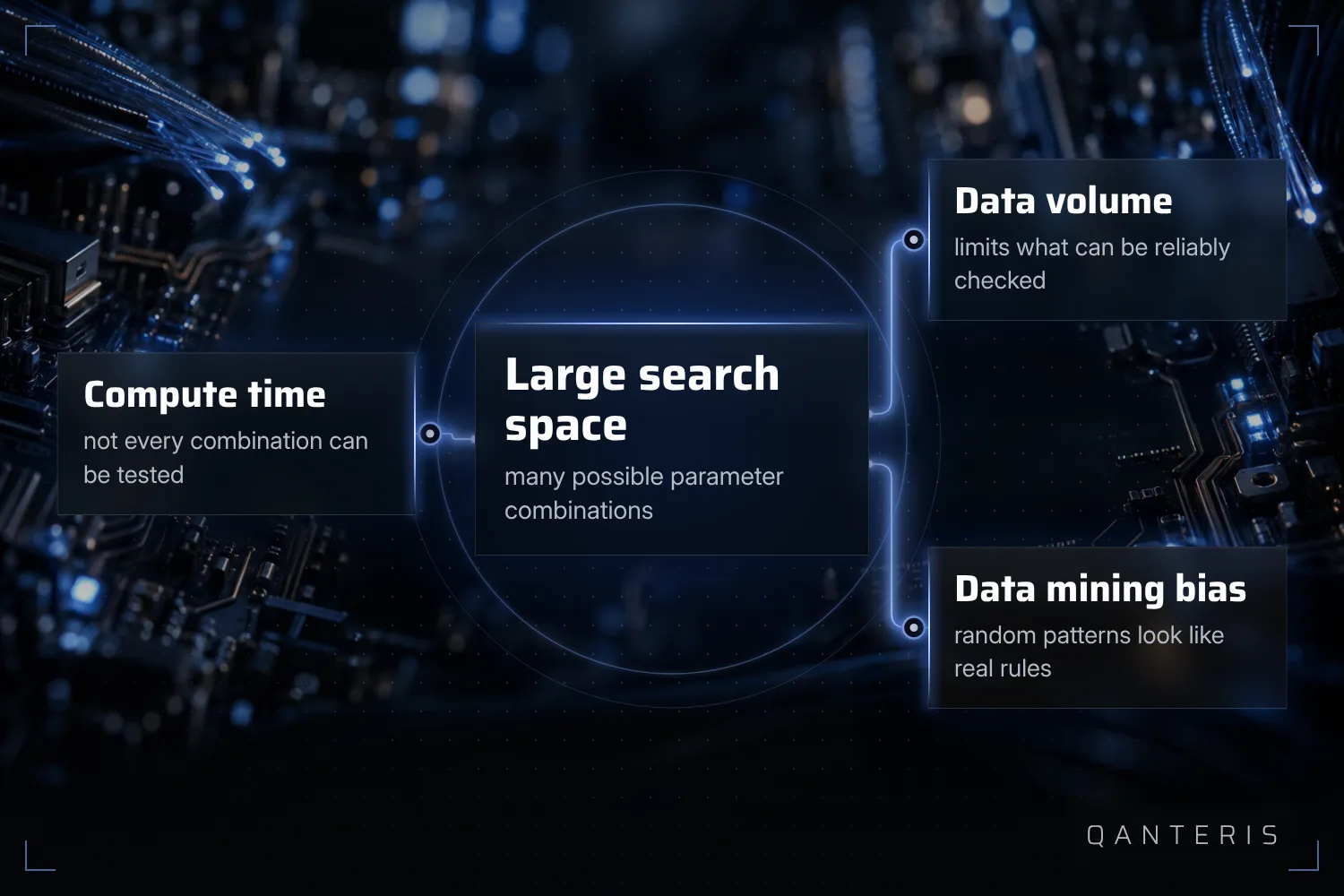
There's a common misconception we keep running into in our tests: more parameters, more degrees of freedom, more possible combinations, surely that leads to better strategies. Real strategies usually have far more parameters than a simple example, and the number of possible parameter combinations ranges from a few thousand up into the billions or trillions. Testing every single one is simply not feasible, no matter how much computing time you have.
Many parameters aren't bad by themselves. But the search space you open up to the Builder should be a deliberate choice, not one that just grows because extra building blocks happen to be available.
When the backtest looks good but says nothing about the future
A common mistake is assuming that a large search will cover everything relevant anyway. If you let a strategy search consider too many parameter combinations, StrategyQuant X can return a strategy whose backtest looks good but that behaves differently in live trading. This pattern is documented as data mining bias: when the search space grows too large relative to the available data and test conditions, the risk rises that the software finds random patterns in historical data instead of a rule that captures something recurring.
That brings us to the most important point in this whole process. A backtest and the number of parameter combinations tested only describe how a rule set behaved on past data, or how large a search space was. Neither one tells you anything about how the strategy will behave on future, still unseen market data. What looked good in the past stays a past observation, nothing more.
What to check in your own idea
Three questions are worth asking before you have your next idea built, even though this article won't answer them for you:
- What default values does the software actually fill in when you leave an exit or trade management field open? Look at it closely in your own build instead of guessing.
- At what threshold does the program warn you that a strategy has too few trades or looks unsuitable for live trading? It's worth paying attention to those warnings instead of clicking past them.
- How closely does an AI-assisted or chat-based strategy generator stick to what you actually entered? Compare the result line by line with your original idea.
These questions are part of your own review. Nobody can do that for you, and this article isn't inventing answers for it either.
Building a rule set means knowing every decision that would otherwise get made for you quietly: entry, exit, trade management, and the scope of your parameter search. A backtest shows you how those decisions played out in the past. It doesn't show you what happens next.
This article is for education only and is not investment advice. Past results, including backtests, do not guarantee future results. Trading financial instruments involves risk, and you can lose money.
This article is for education only and is not investment advice. Past results do not guarantee future results.
How do you do it? Share it in the community. Free, in your language.
Sign up free