Calculate Position Size: Shape Your Risk Profile

If you search for a formula to calculate position size, you'll quickly run into single percentages or fixed lot sizes. But that easily hides the more important point: the model you choose for position size can change more than just the final result of a strategy. It can change the shape of the entire equity curve, shift the balance between profit potential and loss potential, and a backtest only ever shows you how a model would have performed on historical data, not how it will behave under real trading conditions in the future. This article looks at what position size means as a setting, which models are documented, how a single slider like the Size Multiplier shifts several things at once, and how position size decisions also play out at the portfolio level.
What position size really means
Money management, also called position size, is the setting that determines how many lots or shares are traded on each individual trade. That sounds at first like a pure question of quantity, but it isn't: through the traded amount you also control how much capital is actually at risk per trade. Position size is therefore a risk setting, not just a quantity figure.
Three documented models, and the list keeps growing
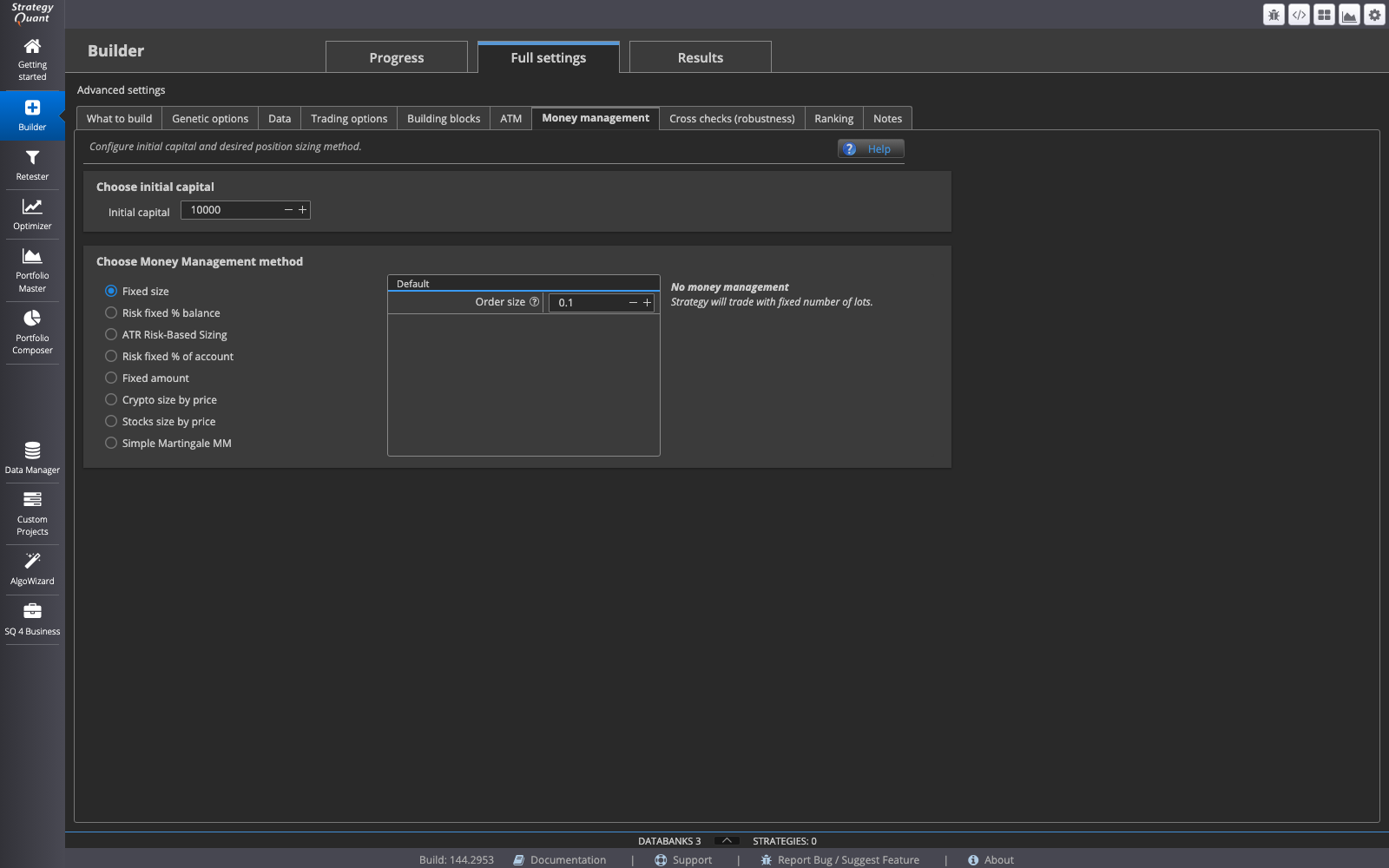
Among others, three models are documented for money management: Fixed size, where every trade uses the same fixed lot size, Fixed amount, where a fixed sum of money is set for each trade, and Risk fixed percent of account, where position size is based on a fixed percentage of the current account balance. These three models differ fundamentally in what they respond to: a fixed number, a fixed amount, or a changing account. Since the software keeps being developed further, the current list may include additional methods beyond these three.
Fixed proportional: one model shapes the whole curve, not just the endpoint
A vivid example of how strongly a model can act is Fixed proportional. Here a fixed lot or contract size is tied to a set percentage of the account balance. If the account balance changes during a backtest, the position size grows or shrinks along with it. The result isn't just a different return compared to a fixed lot size, it's a different equity curve across the whole run: winning phases get leveraged more strongly as capital grows, losing phases get automatically dampened as capital shrinks. That's an effect within a single backtest run with a changing account balance, not proof that the same behavior will continue just as proportionally in live trading.
The Size Multiplier: one number moves several things at once
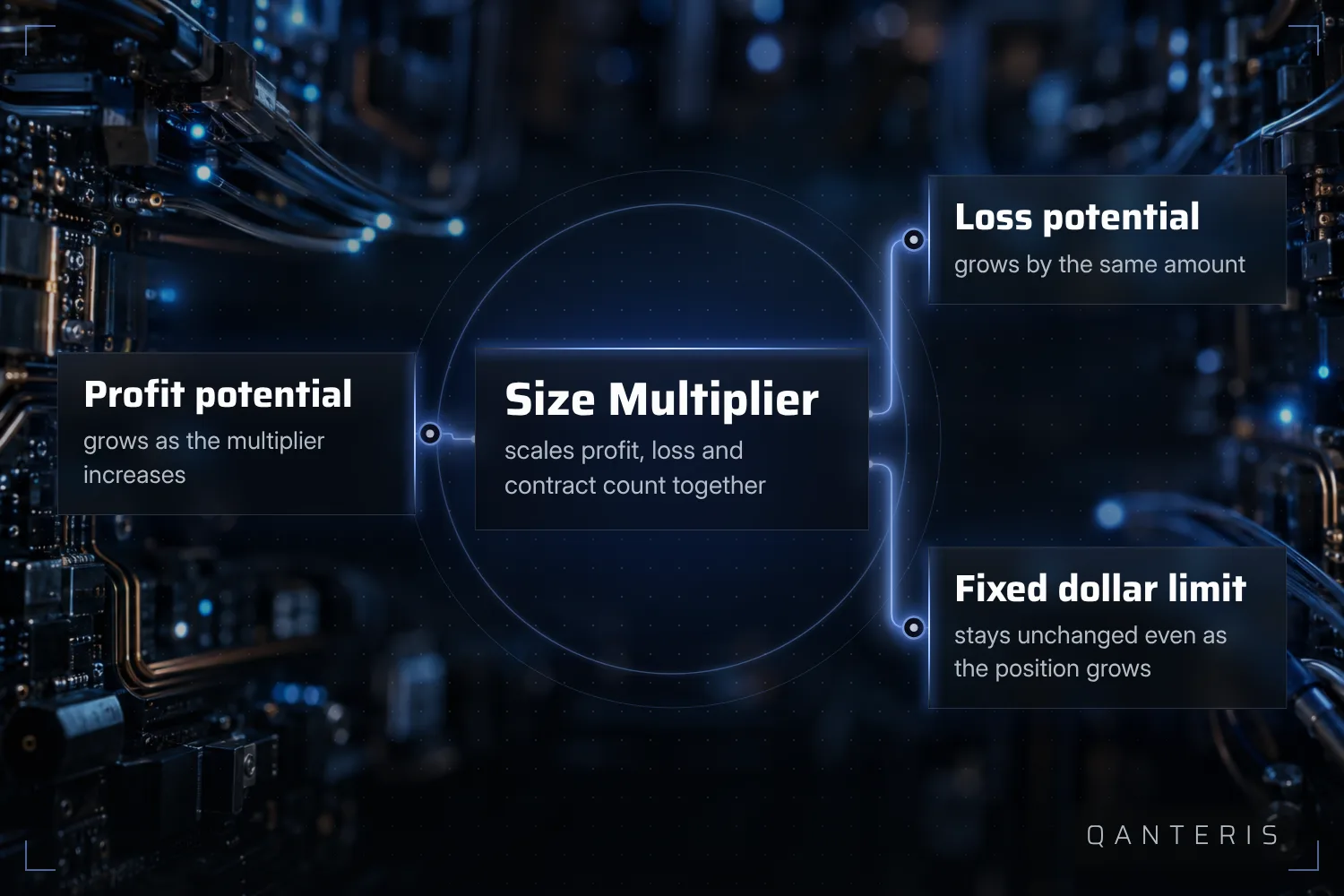
The Size Multiplier is a slider that scales profit and loss, as well as the contract count of every trade, in the same ratio. A value of 1 leaves the backtest unchanged, 2 doubles the position size, 0.5 halves it. At first glance this looks like a pure return scaling. In fact it isn't, as soon as an account or an evaluation program sets fixed limits in dollars, for example a maximum drawdown limit: because that limit is defined as a fixed amount of money while the position size grows, a higher multiplier simultaneously increases both the possible profit potential and the possible loss potential relative to that same fixed limit. A higher multiplier therefore doesn't automatically improve the ratio of reward to risk, and it doesn't automatically lower the danger of breaching such a fixed limit either.
Position size at the portfolio level: the Portfolio Composer
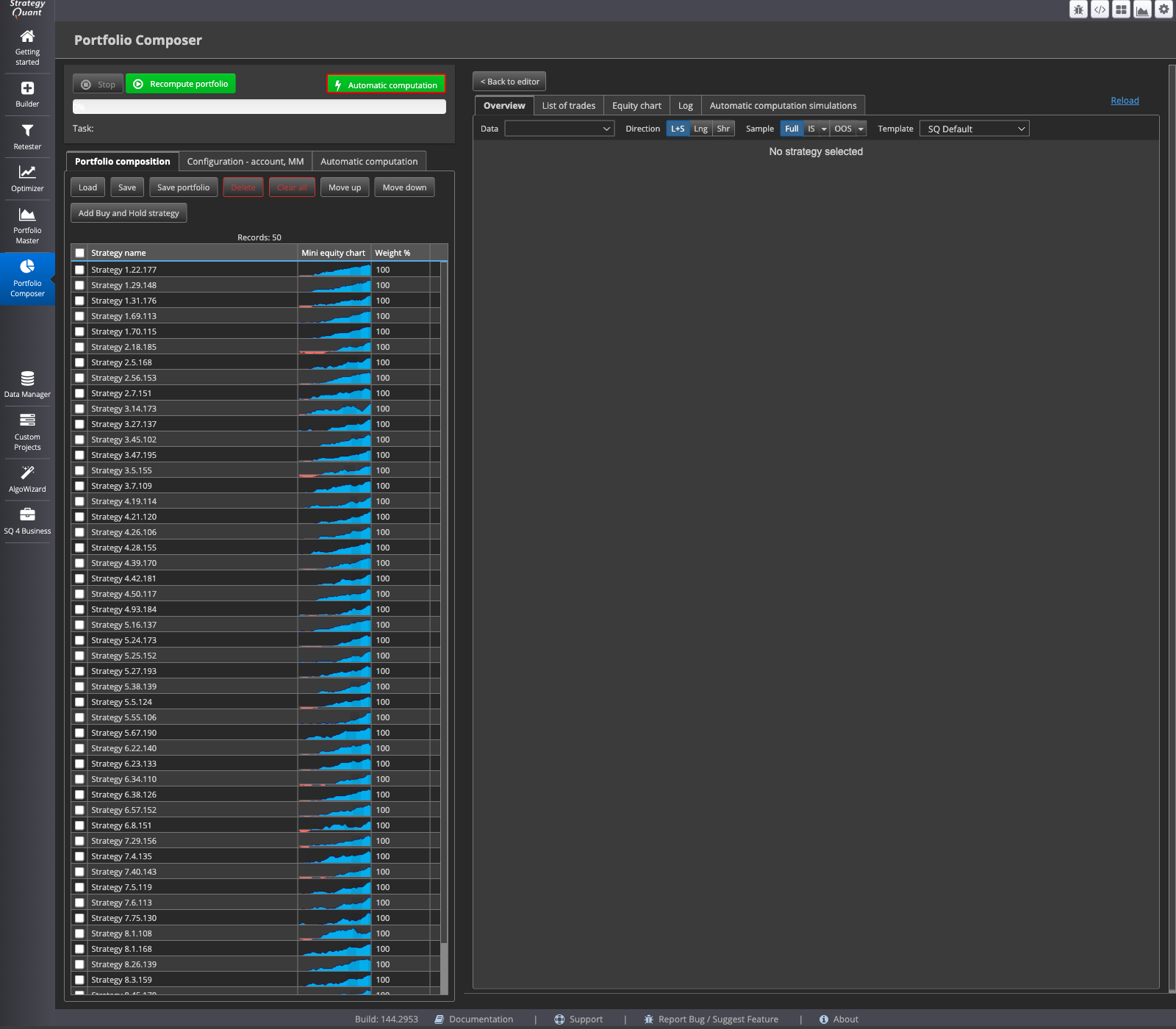
Position size decisions aren't made only per strategy, they also come into play when several strategies are combined into a portfolio. In the Portfolio Composer you can manually put together a portfolio from strategies that are already built: the strategies are loaded, each one gets a weighting assigned, and the Recompute portfolio function calculates the combined result. What weighting makes sense depends on the individual case, and a calculated portfolio result is an evaluation of past data, not a prediction.
What a backtest shows, and what it doesn't show
Each of the position sizing methods mentioned is tested in a backtest against historical data. Results from a backtest, including the effect of the chosen money management model, can differ from results on a trading platform. Common reasons for this include different historical data, differing time zones and trading sessions, different settings for spread, commission and slippage, different order execution, or differing strategy parameters between the two environments. So a backtest shows you how a particular position sizing model would have performed on a particular historical data set, under the assumptions used there. It doesn't show you how the same model will behave under the real conditions of a trading platform in the future. This limit applies no matter how carefully a model was chosen or a curve was checked.
Choosing a position sizing model is therefore not a one-time formula you apply and then forget. It's an ongoing decision about how you weigh capital growth, capital protection and fixed account limits against each other, for each individual strategy and for the portfolio as a whole.
This article is for education only and is not investment advice. Past results, including backtests, do not guarantee future results. Trading financial instruments involves risk, and you can lose money.
This article is for education only and is not investment advice. Past results do not guarantee future results.
How do you do it? Share it in the community. Free, in your language.
Sign up free