AI Trading Strategies: What Machine Learning Really Means

What you were probably looking for
If you searched for "ai trading strategies", you probably expected something like a learning model that studies the market and predicts where prices go next. That is a reasonable expectation, because the word "AI" is used for many different things.
What you actually find behind that term in StrategyQuant X is not one thing but two, and they work differently. One is a search procedure that builds and filters large numbers of rule combinations against historical data. The other is a prompt-based assistant that turns a written description into a set of trading rules. Neither of them studies the market and tells you what will happen tomorrow. Both of them still need to be tested afterward. The rest of this article separates the two, so you know what you are actually looking at when you read "AI" on a trading platform.
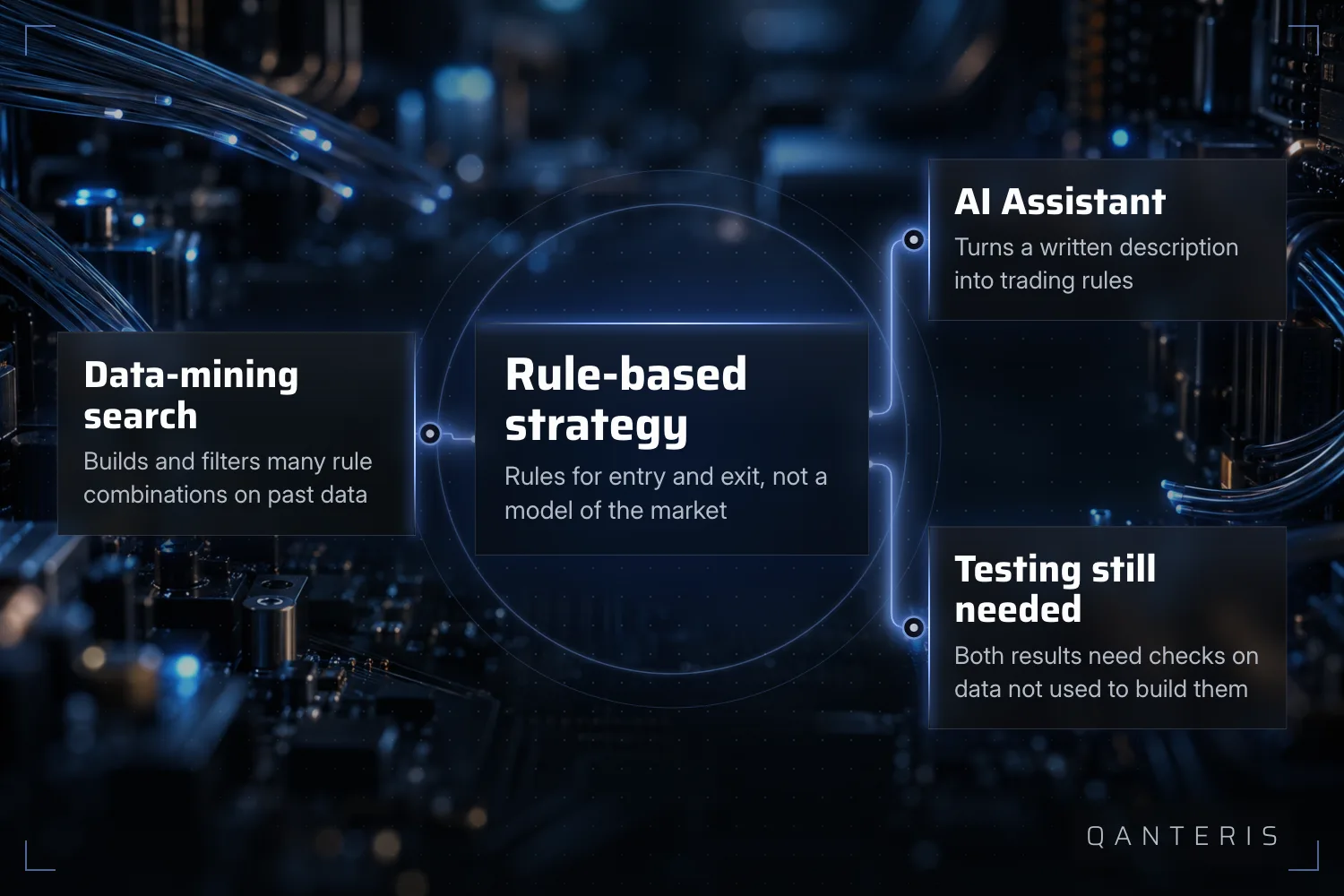
The search engine: testing rule combinations, not learning a market law
Documentation for the platform draws a clear line between two ways of building a strategy. The classic way is building a strategy from scratch by hand, without any data-mining technique, which corresponds to manual building in the AlgoWizard tool. The other way is a data-mining approach: a large number of candidate rules are generated and tested, and the strategy with the highest observed performance on the historical data is kept.
This second approach is what people usually mean when they talk about the "AI" in the strategy builder. In plain terms, the software tries out many combinations of entry rules, exit rules and filters, checks each one against past price data, and keeps the combinations that performed best on that specific stretch of history. That is a search and filtering process. It is not the same as a model that has learned a general rule about how markets behave. The strategy that comes out was chosen because it fit the tested history well, which is a different thing from a strategy that will keep fitting whatever the market does next.
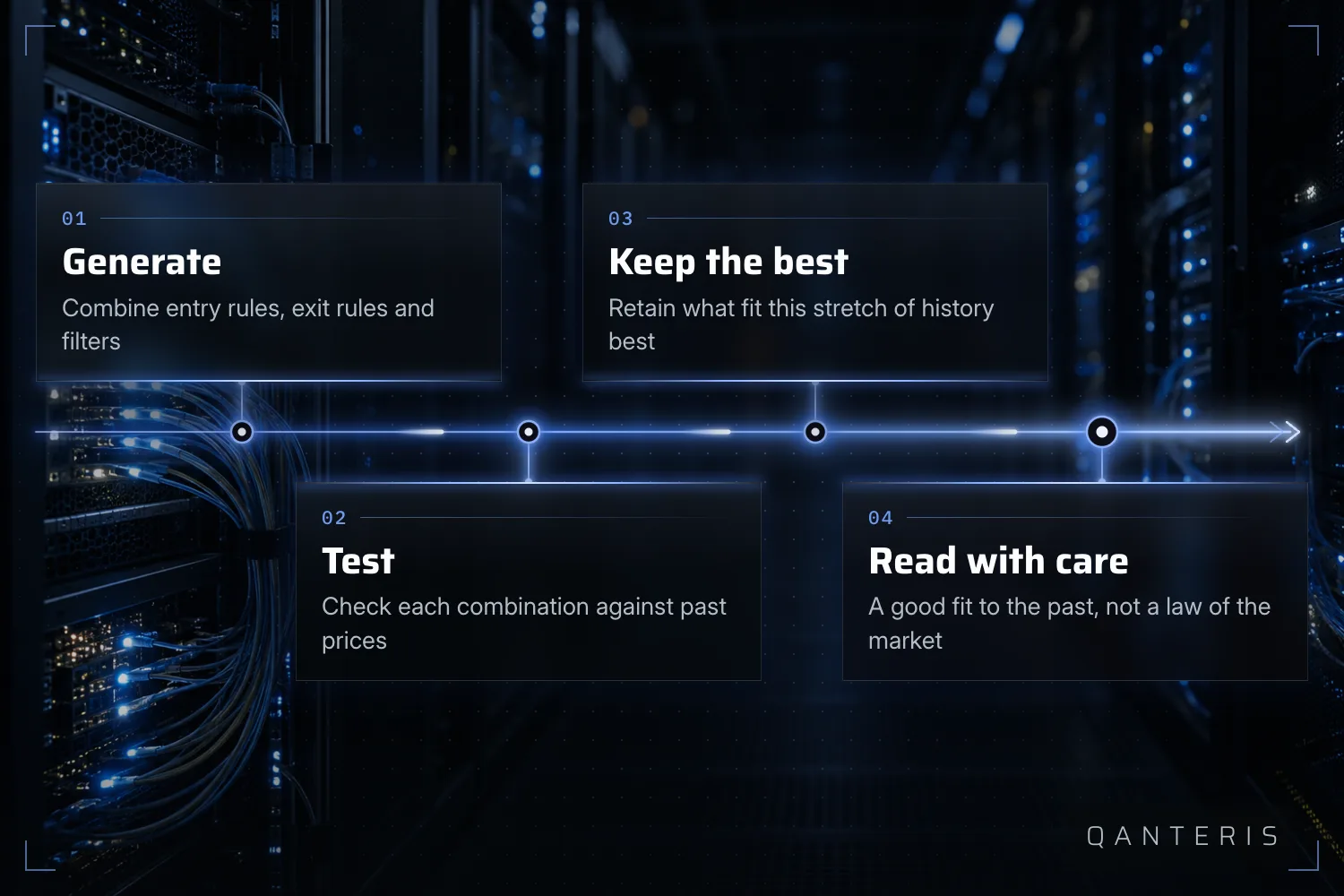
The AI Assistant: turning a sentence into a set of rules
Separate from the search engine, there is a family of features described in the documentation as an "AI Assistant" or similar. They work from natural-language prompts instead of from a generate-and-filter search.
One feature, announced as "AI Assistant", is described as able to build a trading strategy from a prompt for MetaTrader 4, MetaTrader 5, TradeStation or MultiCharts, with the target platform chosen at the moment the strategy is created. At the time this feature was announced, it was in beta.
A separate, built-in AI Assistant is described as based on the ChatGPT and Claude language models. It can generate a trading strategy from a natural-language description, and it can also be used step by step to improve an existing strategy. When this was documented, it was available only for the stock-picking engine.
A further module, called SQ AI Wizard, is described as letting users create trading strategies by entering simple text prompts.
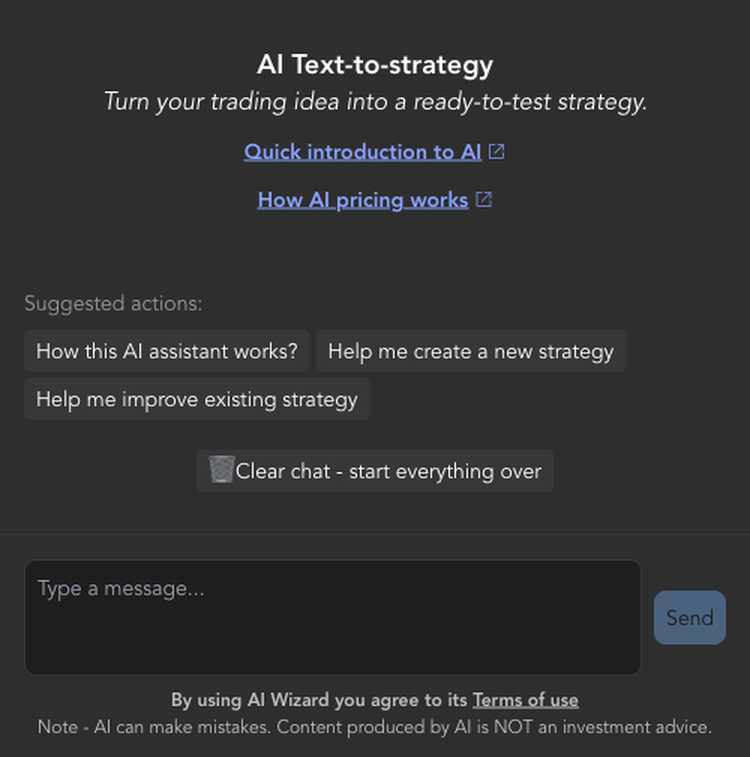
What all three have in common is the underlying idea: you describe what you want in words, and the assistant translates that description into a rule-based strategy. It does not build a model of the market from your words. It produces the same kind of rule-based strategy that the search engine produces, just through a different entry point. That strategy still needs the checks described further down in this article.
Why the company calls itself a machine-learning business
The company behind StrategyQuant X describes itself as a fintech software development company specializing in algo trading and machine learning. That is a self-description from the company's own materials, not an independently verified technical claim about a specific method used inside the software.
A separate article series from the same source states that its content is based on a study conducted in 2019 and 2020 into the methodology for evaluating and selecting strategies generated with the software. That study is several years old at this point, and the methodology or the product itself may have changed since. It is useful background for where some of the vocabulary comes from, but it should not be read as a description of current behaviour without checking whether it still applies.
Checking what came out: optimization analysis and Monte Carlo
Whether a strategy came from the search engine or from an AI Assistant, the platform documents further steps meant to check it, not to build it further.
Two of these are Optimization Profile and System Parameter Permutation. Both require that the strategy's parameters have already been optimized. The methods are then applied to the results of all the optimization runs, not to a single run in isolation. In other words, they look at how a whole set of parameter variations performed, rather than at one lucky combination.
Another documented method is Monte Carlo analysis. It works by repeating the same simulation many times with small random changes each time. According to the documentation, a higher number of repetitions increases the statistical significance, or reliability, of the results. That is a statement about how the method behaves, not a promise that more repetitions make a strategy correct. A large number of repeated simulations can still be repeating the same underlying weakness.
The risk both mechanisms share: fitting to the past
The documentation names curve fitting, meaning overfitting a strategy to the specific historical data used to build it, as the biggest risk for strategies produced through a machine-learning or data-mining style search. This applies before any further robustness testing has been done, whether the strategy came from the genetic search or from an AI Assistant, since both are fitted to a chosen stretch of historical data.
Because of that fitting, any backtest or optimization result shown for a strategy built through automated search or an AI-based generator describes the strategy's past behaviour on that specific data only. On its own, that result does not indicate how the strategy will perform on future, unseen market conditions. A strong-looking backtest at this stage tells you the strategy fit the tested history, it does not tell you what happens next.
What this method can tell you, and what it cannot
Put the two mechanisms next to each other and the picture becomes simpler than the search term suggested. The data-mining search tests many rule combinations and keeps the ones with the best observed historical performance; it does not discover a hidden law about how the market moves, it finds a good fit within the history it was tested against. The AI Assistant translates a written description into that same kind of rule-based strategy; it does not build a forecasting model either. In both cases, the number you see after building or after optimizing describes what happened on past data, not what will happen going forward.
That is a limitation of the method itself, not a gap in what you were told about it. A rule-based strategy, however it was produced, still needs the kind of checking described above, including testing on data that was not used to build it, before you draw any conclusion about how it might behave in conditions it has not seen.
This article is for education only and is not investment advice. Past results, including backtests, do not guarantee future results. Trading financial instruments involves risk, and you can lose money.
This article is for education only and is not investment advice. Past results do not guarantee future results.
How do you do it? Share it in the community. Free, in your language.
Sign up free